
This report analyses ODA's role in delivering social protection in Uganda. It examines the success of an aid-recipient programme and presents lessons for donors.
DownloadsRecent challenges, including the Covid-19 pandemic and conflicts around the world, have negatively impacted Uganda’s domestic revenue collection, and changed donor countries’ aid policies, widening Uganda’s budget deficit. Moreover, official development assistance (ODA) now faces enormous pressures from growing, competing demands, including humanitarian and crisis response, national development priorities and investment in global public goods. Development Initiatives (DI) seeks to highlight the value of ODA in programmes that are national priorities to recipient countries. Additionally, DI aims to enhance the understanding of enabling factors that contribute to improving aid impact.
Led by national demand for international finance data and evidence on its most appropriate use, DI embarked on producing a series of country case study reports to consider how aid has been effective in specific development sectors in Kenya, Ethiopia and Uganda, including trends, the factors that unlock the value of aid, and the challenges that lie ahead.
This country report for Uganda provides evidence on the role and contribution ODA in the delivery of social assistance programmes. It first provides a background and overview of ODA disbursements to Uganda – both generally and specifically to the social protection sector. Then, drawing on secondary data obtained from various impact evaluation studies and key informant interviews, the report highlights how ODA and other factors have enabled the establishment and implementation of Uganda’s flagship Expanding Social Protection (ESP) programme.
You can read this overview and the executive summary below, or download the full report.
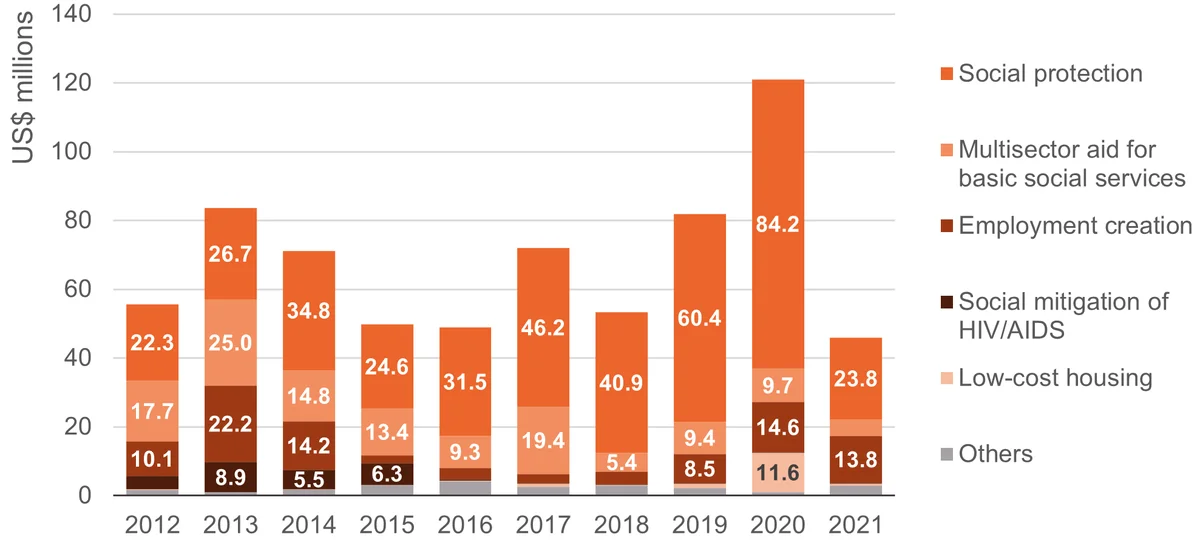
The report finds that between 2012 and 2021, just 2% of ODA disbursed to Uganda went to the social protection sector. Total ODA to social protection in Uganda has grown rapidly: in 2015, with the onset of the implementation of the second phase of the ESP programme, it reached US$24.6 million; by 2020 it had peaked at US$84.2 million due to an increase in disbursements to support the government’s response to the Covid-19 pandemic. The growth in ODA disbursements to social protection from 2015 to 2021 was coupled with increasing government commitment to financing the expansion of social protection and increasing coverage of the ESP programme, from the initial 15 pilot districts to the entire country. Disbursements sharply declined to US$23.8 in 2021 as funding for ESP ended.
Our review of impact evaluation reports shows that ODA played a significant catalytic role in the development of critical social protection systems and structures in Uganda. This paved way for the eventual rollout and expansion of the ESP programmes studied. The ESP programme improved the welfare of beneficiary households who were able to use cash transfers to invest in productive assets, education and health. Factors beyond ODA that enabled this success include government ownership and commitment, alignment of donor priorities to government development aims, and multistakeholder partnerships. Read our executive summary for more detailed findings and lessons for the effective investment of ODA in social assistance programmes and other donor funded initiatives.
► Read more about our work in Uganda
► Share your thoughts with us on Twitter or LinkedIn
► Sign up to our newsletter



This report uses aid data from the OECD DAC which is complete and verified and thus presents an important and detailed picture of trends. OECD DAC data is, however, published at least a year in arrears, meaning that the latest detailed data available is up to 2021. The analysis therefore covers the period between 2012 and 2021 and uses gross disbursements.
In this report, the term ‘aid’ encompasses development assistance but excludes all humanitarian aid. Aid here includes ODA (as defined by the OECD DAC) and equity investments reported by official actors to the OECD.
Due to Uganda’s limited capacity to mobilise domestic resources, the country has needed to rely on official development assistance (ODA). Recent challenges, including the Covid-19 pandemic and Russia’s war in Ukraine, have negatively impacted domestic revenue collection and changed donor countries’ aid policies, widening Uganda’s budget deficit.
This report presents key trends in ODA between 2012 and 2021 and assesses its effectiveness in Uganda using a case study on ODA financing for the Expanding Social Protection (ESP programme). The ESP targets social protection to people experiencing the most extreme poverty. It started in 2010, with the aim of putting in place a national social protection system aligned with Uganda’s National Social Protection Policy (NSPP). The programme started with donor support for the implementation of a pilot phase of the senior citizens grant in 15 districts that ran until 2015 (phase one). During phase two of the programme (2015 to 2021), the coverage was subsequently scaled up to cover the entire country following the government’s 2018 decision to roll out the grants to all districts. ESP is now rolled out as a key pillar of the social protection approach in Uganda.
As well as key findings, we provide lessons and recommendations for improving the effectiveness of ODA, especially government and donor staff who plan and fund programmes.
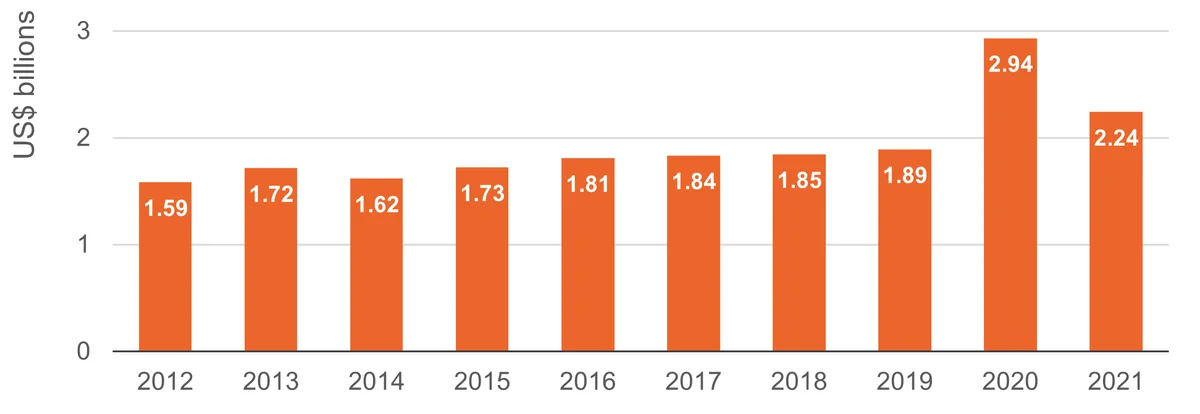
ODA disbursements to Uganda (constant figures in US$ billions), 2012–2021
placeholder
Source: Development Initiatives based on data from OECD DAC.
placeholder
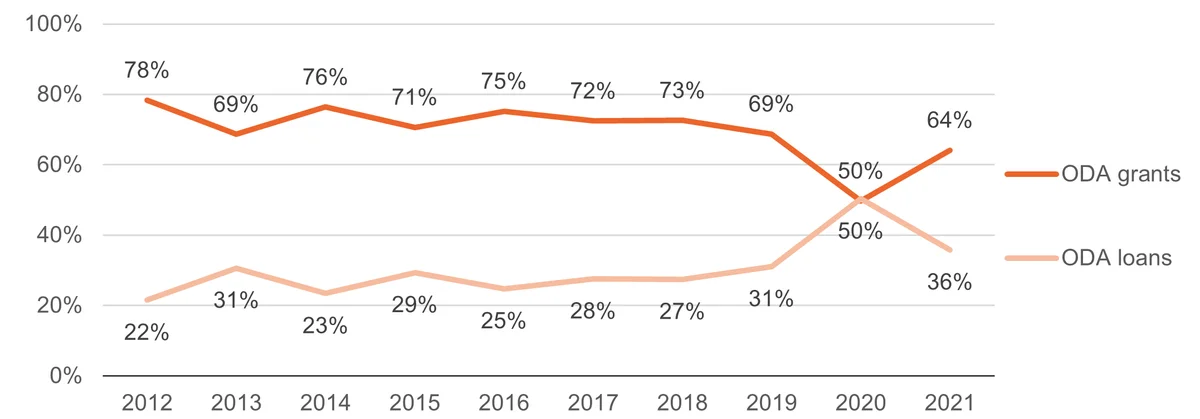
Source: Development Initiatives based data from OECD-DAC.
Notes: The increase in ODA grants in 2021 is attributed to the Covid-19 response. Equity investments accounted for 1.4% of total ODA disbursements from 2012 to 2021 (0.1% in 2012, 0.8% in 2013, 0.2% in 2014 and 0.3% in 2019).
The overall growth in ODA from 2012 to 2021 was driven by the increasing share of concessional loans. Grants remain predominant but declined as an overall proportion of ODA over the same period. On average, the year-to-year growth in loans was 20% compared to 2% for grants.
At 2%, the share of ODA to social protection in Uganda is higher compared to another recipient country like Kenya (1.3%) for the same period. ODA for social protection has been instrumental in building capacity, providing technical assistance and financing the implementing social protection programmes. This funding has supported the Expanding Social Protection (ESP) programme, as well as the Northern Uganda Social Action Fund (NUSAF) and the Development Response to Displacement Impacts Project (DRDIP), all of which are now key pillars for social protection in Uganda.
placeholder
Source: Development Initiatives based on data from OECD-DAC.
Notes: ‘Others’ includes culture and recreation, housing policy and administrative management, labour rights, social dialogue, and statistical capacity building activities and services.
The pilot for the national ESP programme was 100% ODA funded, showcasing the impact of donors on social protection in Uganda. Some successes of the pilot programme included the completion and launch of Uganda’s NSPP, the expanded coverage of direct cash transfers to more people facing vulnerability, and the scale-up of the direct cash transfer programme to all districts in Uganda.
While a few donors continue to support the ESP programme, low funding for social protection remains a major challenge for the government. This has limited the depth of coverage under the current phase of the programme in which the government has belatedly (in 2021) started to roll out coverage to the entire country. Only 20% of eligible beneficiaries have been actively reached so far.
There are several important lessons about aid effectiveness to be drawn from the case study. These could maximise the impact of aid in heavily donor-funded development programmes.
This report looks at the use of ODA in programmes with a gender focus in the health and agriculture sectors in Ethiopia, and how an enabling environment can be fostered for development outcomes.
This report provides background on the role of ODA in delivering social assistance in Kenya. Using three case study programmes, it examines aid disbursement trends, programme impacts and key lessons.
This briefing explores the role of ODA in delivering social protection programmes in Kenya. We explore three case study programmes, and examine their successes, challenges and financing opportunities.