
This briefing supports Kenya's Inclusive Data Charter Action Plan 2021−2025. It identifies disability data sources, assesses the disability data ecosystem and makes recommendations for improving it.
DownloadsIn 2018, Kenya’s Ministry of Labour and Social Protection committed to promoting the collection of accurate data on persons with disabilities for use in planning and programming by signing up to be an Inclusive Data Charter (IDC) Champion. In November 2021, the government of Kenya launched its IDC Action Plan 2021–2025, outlining how it will promote and collect high quality, inclusive data on people with disabilities.
This briefing supports that action plan. It helps government staff identify relevant, usable disability data sources that they can employ when creating plans and policies.
Given Development Initiatives’ (DI) strong data landscaping track record across multiple countries on the African continent and beyond, the Government of Kenya engaged DI to support the implementation of their IDC Action Plan by:
DI adapted its general analytical framework for data landscaping to apply to disability data in Kenya. Data landscaping refers to the systematic process of mapping, analysing and understanding the availability, quality and useability of data within a specific ecosystem. Desk research and key informant interviews (KIIs) were conducted with 19 stakeholders from government, organisations of persons with disabilities (OPDs) and non-governmental organisations (NGOs). These KIIs were completed between January and March 2023.
The first section of this briefing describes the quantity and quality of data included in the comprehensive national disability data inventory (available to download as an Excel file), in addition to details on the sources, producers and tools used to gather disability data in Kenya and the variables available for disaggregated analysis for each source.
The real value of data is not in its existence, but rather in its use. As part of the data landscaping approach, in the second section of this briefing DI assesses how data is accessed and used and some of the challenges.
The assessment also reviewed the strength of the disability data ecosystem as a whole, beyond the properties of individual data sources. It was able to question perceptions that “data on persons with disabilities is limited” (United Disabled Persons of Kenya (UDPK)) and that “[there is an] invisibility of persons with disability due to inadequate [disability] disaggregated data” (Kenya Leave No One Behind Initiative).
Instead, it found a newly emerging set of circumstances consisting of legislation, plans (including the IDC Action Plan), a technical working committee and official and unofficial data. The third section of this briefing provides the findings from this assessment, and the fourth section makes recommendations for improving the disability data ecosystem in Kenya. The recommendations include:




| Organisation |
Number of publications |
|---|---|
| KNBS | 9 |
| KNEC | 7 |
| NCPWD | 4 |
| UDPK | 3 |
| KISE | 3 |
Source: Kenya Disability Data Inventory (compiled by DI).
Notes: KNBS = Kenya National Bureau of Statistics; KNEC = Kenya National Examinations Council; NCPWD = National Council For Persons With Disabilities; UDPK = United Disabled Persons of Kenya; KISE = Kenya Institute of Special Education
Over the course of this study, DI compiled an inventory of the disability data sources that have been published over the last 10 years. The sources are categorised into official or non-official surveys, census data, administrative data or qualitative data. Using these categories, 44 sources were captured. Of these, 32 were produced by government agencies and 12 were produced by organisations outside of government (the list is not completely comprehensive, and it should be noted that non-official data is likely to be harder to locate and access than government data) (see Figure 1). The Kenya National Bureau of Statistics (KNBS) published the most data sources included in the inventory (9) followed by the Kenya National Examinations Council (KNEC) (7).

|
Data category |
Number of disability data publications |
|---|---|
|
Official survey data |
15 |
|
Non-official survey data |
8 |
|
Official administrative data |
7 |
|
Mixed official data |
7 |
|
Official qualitative data |
2 |
|
Non-official qualitative data |
2 |
|
Non-official administrative data |
2 |
|
Official census data |
1 |
Source: Kenya Disability Data Inventory (compiled by DI).
Notes: ‘Mixed official data’ includes survey, census and administrative data.
Survey data collected by government bodies is the most commonly published (15), followed by survey data collected by non-government entities (8).
|
Year range |
Number of publications |
% |
|---|---|---|
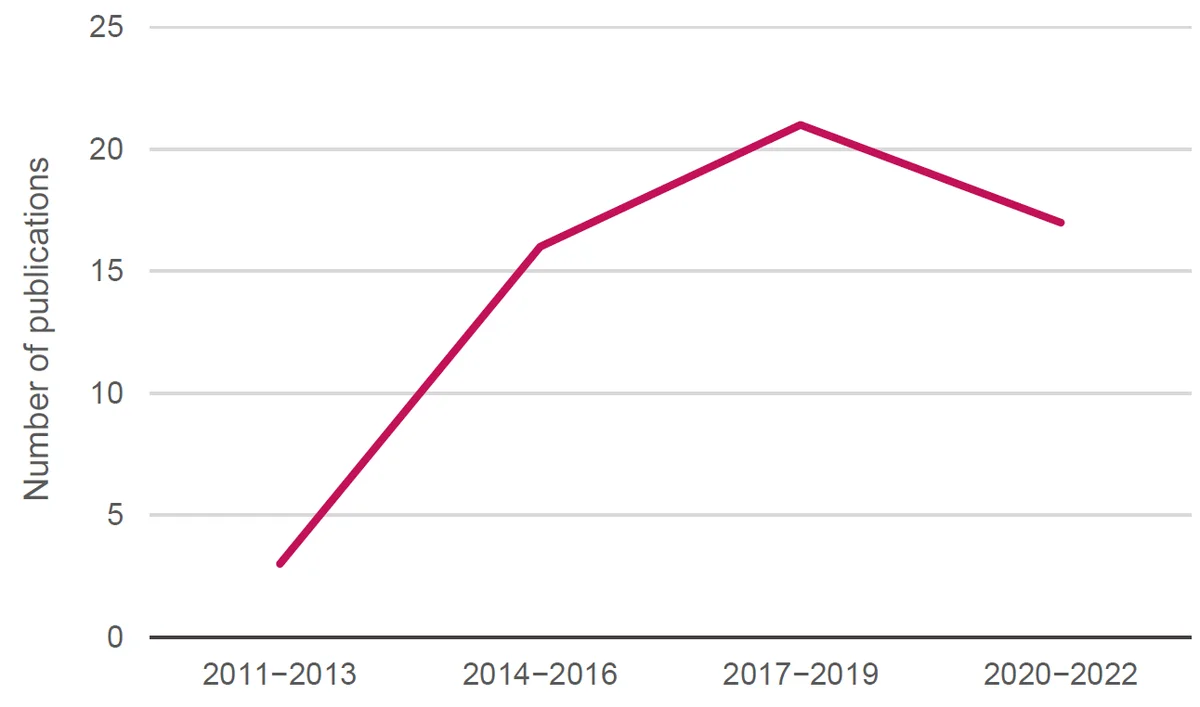
| 2011−2013 | 3 | 5.263158 |
| 2014−2016 | 16 | 28.07018 |
| 2017−2019 | 21 | 36.84211 |
| 2020−2022 | 17 | 29.82456 |
| 57 |
Source: Kenya Disability Data Inventory (compiled by DI).
|
Year Range |
Non-official | Official |
|---|---|---|
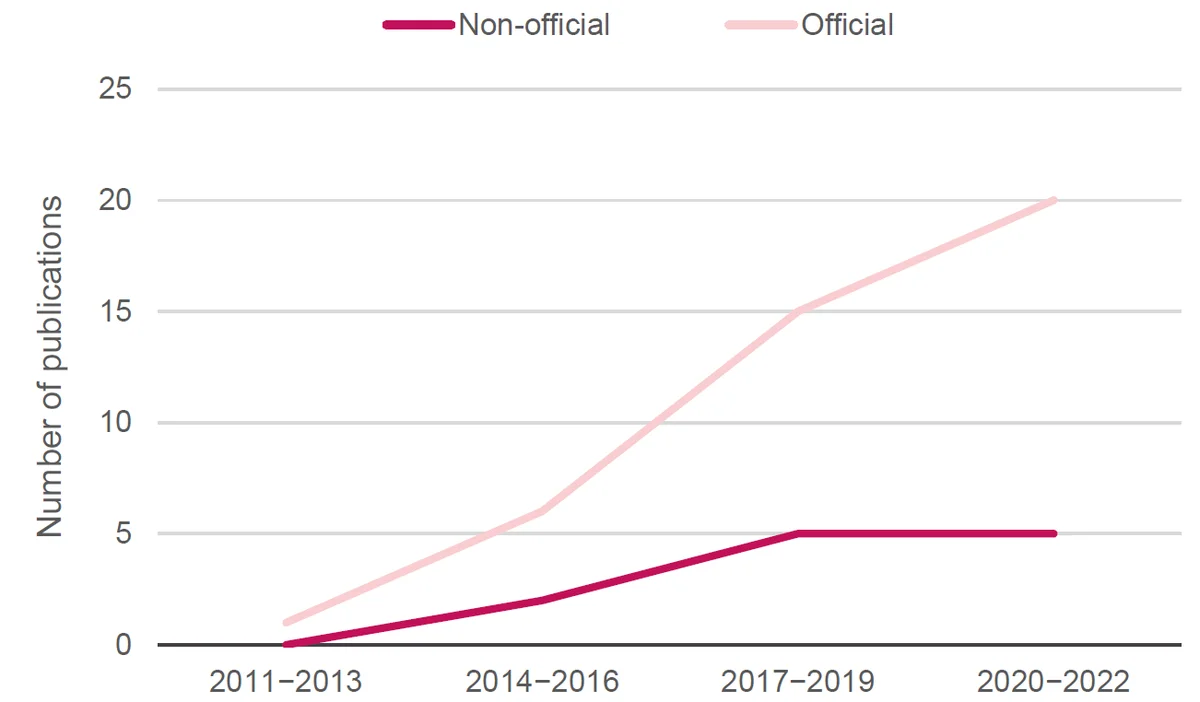
| 2011−2013 | 1 | |
| 2014−2016 | 2 | 4 |
| 2017−2019 | 5 | 10 |
| 2020−2022 | 5 | 15 |
Source: Kenya Disability Data Inventory (compiled by DI).
83% of data in the inventory has been published since 2017. Only 29% has been published since 2020 alone, meaning that there has been a slight downwards turn in the number of disability publications published in recent years. The general decrease in the amount of data sources being published more recently is mostly due to reduced activity and funding due to the Covid-19 pandemic compared to the other periods being measured.
| Sector | Count of Sector |
|---|---|
|
Child protection |
2 |
| Demographics | 1 |
| Economy | 5 |
| Education | 34 |
|
Government spending |
2 |
| Health | 4 |
| Housing | 2 |
|
Prevalence and Registration |
7 |
| Total | 57 |
Source: Kenya Disability Data Inventory (compiled by DI).
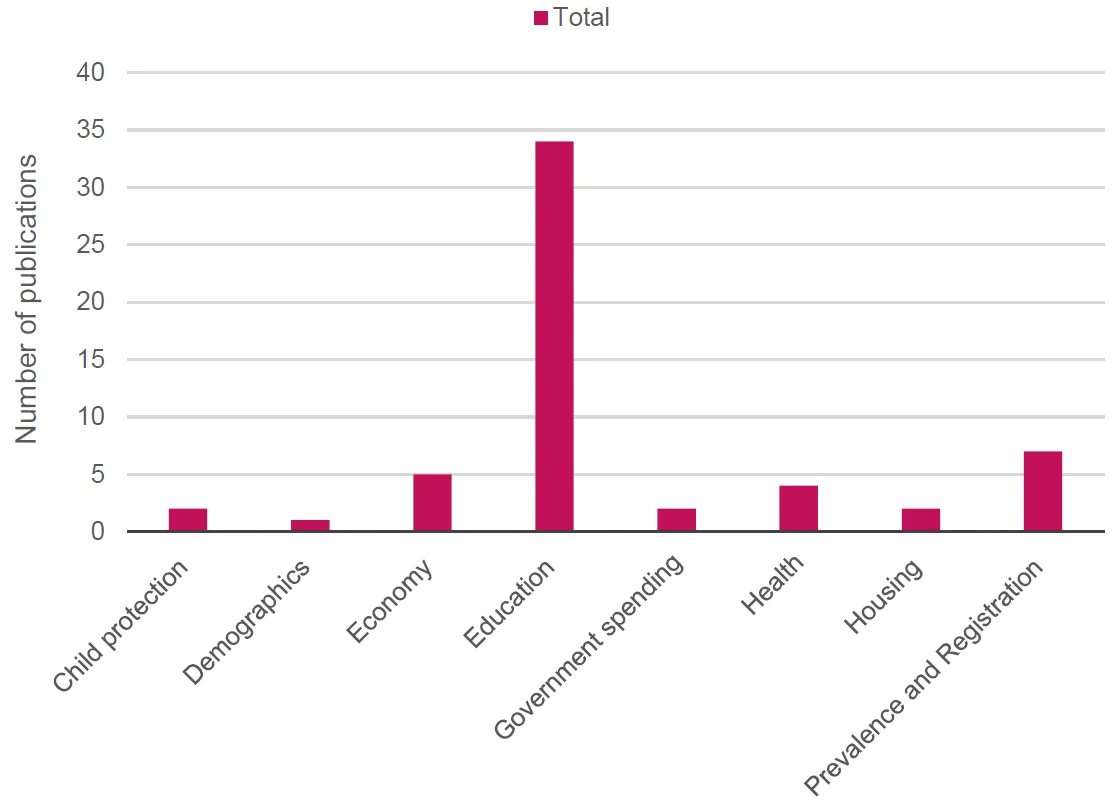
The clear majority of data publications (60%) were about education. The next most popular category − disability prevalence estimates − had five times fewer – this was (12%). The third most popular was economic circumstance (9%). Other categories with low numbers of publications were health, access to government services and political participation.
| County | National | |
|---|---|---|
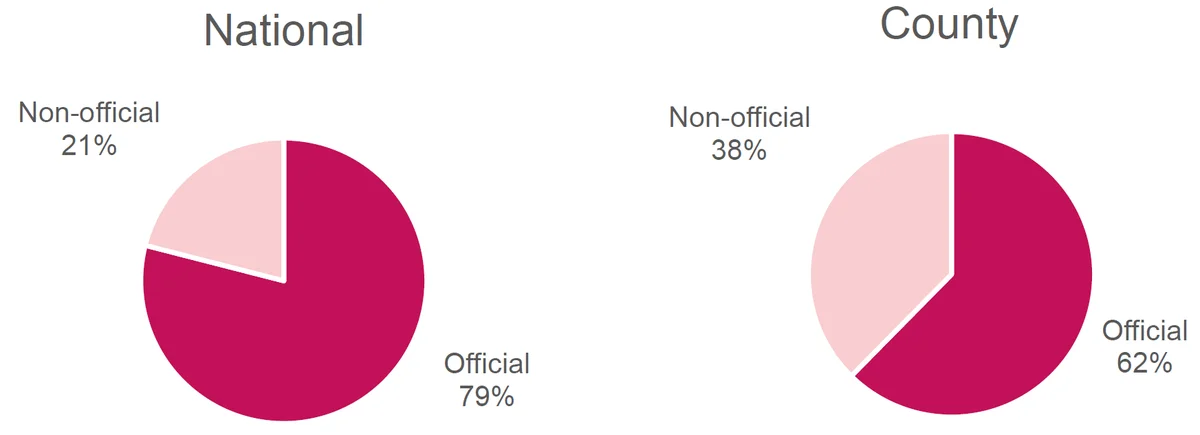
| Official | 0.63 | 0.79 |
| Non-official | 0.38 | 0.21 |
Source: Kenya Disability Data Inventory (compiled by DI).
The geographic scope of the data in the sources varies widely: 43% of publications provide national-level data, 30% provide county-level data, and 3% provide data from specific local facilities such as health centres, while the remaining 24% cover a mixed array of categories.
Around four-fifths of national-level data publications feature official data (79%). This figure drops to around three-fifths in county-level data publications (62%).
The inventory also contains information for each source on the classification of disability used (e.g., Washington Group), methodologies used (e.g., household survey, KII, focus group discussion), technical and financial supporting organisations, and sample sizes.
The classification of disabilities across the different sources in the data inventory vary. The data sources with different classifications are not comparable. In addition to this, because the majority of the data comes from surveys, it relies on self-reporting by respondents. This is not a negative in itself, however a fully working disability registry would create an up-to-date database, which is based on professional assessments and standardised categorisation in accordance with the legal definitions. This would serve as an important baseline for comparison with data collected by surveys, as well as to lay the foundation for a more efficient statistical system centred on administrative data.
Diverse data is not interoperable and not easily accessed outside of the originating institution, limiting its use.[1] There are no open data protocols in place in Kenya, and data is not often easily accessible outside of the collecting institution, stifling its wider use. For example, when KNBS carried out a survey on behalf of the National Council for Persons with Disabilities (NCPWD), the bureau could share only the public report with the council. The granular data could not be provided due to data protection measures and limitations on data sharing despite both being government agencies. This means that the NCPWD has not completed additional analysis using the raw data and cannot generate extra value by generating its own insights.
Similarly, if actors wish to access disaggregated reports from the National Education Management Information System they must write a letter to the relevant director requesting them. While making data available to a broad audience carries certain risks, such as the potential for commercialisation, it’s essential to strike a balance between ensuring data privacy and promoting its constructive use. If the data isn’t disaggregated, writing a request for information letter can demonstrate genuine and legitimate interest in using the data for a beneficial purpose. However, there are instances where this level of bureaucracy may not be necessary, particularly when the data’s application is consistent with the broader goals of education research or policymaking and the data in question is disaggregated. In such cases, streamlining access can foster a culture of data use without compromising data integrity. There are multiple examples from around the world where effective open data policies have been able to achieve this.[2]
KNBS is responsive to disability data challenges and new opportunities but limiting factors (such as siloes within the data ecosystem) mean it lacks oversight and responsibility of official data, which it is mandated to collect.
KNBS has shown it can be responsive to challenges posed by disability data while acting within the limits it faces, such as not having the necessary oversight, budget and responsibility where disability data is concerned. For example, it has taken the positive step of including the Washington Group Questions (WGQs) in past data collection activities and has committed to using them in the future. However, despite the use of an adapted set of WGQs in the 2019 national census, the prevalence rate it reported was viewed as being unexpectedly low.[3] In Status of disability in Kenya: Statistics from the 2019 census, DI highlighted a number of reasons that could have caused underreporting, including:
KNBS has also been exploring other ways to increase the volume and quality of disability data being produced. In association with the SDGs Kenya Forum, the bureau is currently conducting an inventory exercise to map civil society organisations that collect citizen-generated data (CGD). This is with a view to finalising quality criteria for CGD and to creating data channels that link civil society and the bureau.[4]
There are challenges that KNBS is yet to address in a meaningful way. The bureau is the government body mandated to collect all official data within the country, but its oversight does not extend to other ministries’ administrative data systems including, for example, NCPWD’s registration system. There is therefore no central body that maintains standards, or that can coordinate and collate all official disability data produced in Kenya. As such, the full spectrum of government-produced data lacks alignment, there is no holistic view of the entire disability sector in terms of data, and for the most part systems are not interoperable and operate in silos.
No statutory body is legally mandated to assess persons with disabilities prior to registration. The Persons with Disability Act (2003) established the NCPWD as the focal agency on disability: section 7 subsection C mandates the council “to register persons with disabilities”, but does not outline the process for doing so.[5] In practice, the NCPWD can register a person with disabilities only after they have been assessed by the Ministry of Health (MoH).[6] While the MoH is not legally mandated to carry out the medical assessment, and there appears to be only an informal agreement between the two bodies, assessments are still carried out.[7]
Each year the NCPWD aims to register about 100,000 persons with disabilities, however the actual number registered is consistently much lower. This is largely because the MoH does not complete enough assessments. The MoH has difficulty obtaining the government funding needed to perform more assessments due to the lack of legislation, and therefore significantly lacks capacity.[8] If legislation covered the whole registration process, by fully mandating the MoH, the challenges would be reduced.[9]
Progress is being made on implementing disability data strategies, but the benefits of using disability data and data systems are not yet realised. The plans, policies and strategies of national state actors document ambitions to create operational and well-developed management information systems (MISs).[10]
The National Council for Persons with Disabilities strategic plan (2018–2022) recognises the current gaps in the disability data ecosystem and the impact they have.[11] To overcome them, the strategy sets out the thematic area objective: “to enhance [the] availability of information and data on persons with disability to inform policy and programme decisions”, and recommends:
In addition to this, the Sector Plan for Gender, Youth and Vulnerable Groups (2018–2022) highlights that the State Department for Social Protection will:[12]
Not all of these targets have been met but significant developments have been made towards some. For example, the NCPWD launched a new system to register persons with disabilities in December 2021 and this was fully operational by mid-2022. Critically, the government recognises how leveraging information from the registration system can greatly augment the disability data ecosystem.
“By enhancing data collation, it is possible to analyse how many children have disabilities or develop disabilities and the main causes (disabilities caused by malnutrition related diseases, disabilities caused by gender-based violence, disabilities caused by harmful cultural practices like female genital mutilation). By further interpretation, it can be possible to establish if the instances are local or more widespread”, and “Analysis of data on causes of disabilities and at what age they are acquired can provide tools that can potentially shift the approach the health sector takes on rehabilitation and prevention of disabilities (access to adequate and affordable pre and post-natal care, diseases that cause certain disabilities and their prevalence rates)”
National Council for Persons with Disabilities
Moreover, the new system can be linked to other key information systems in the country including those managed by the MoH and Kenya Revenue Authority. It should be emphasised, though, that the new system does not address the legal issue that underlies the MoH’s role in the registration process.
Disability data is significantly underfunded, impacting the quality of data collected and the role of KNBS. Throughout the KIIs, stakeholders unanimously stated that disability data is significantly underfunded by government and unofficial actors.[13] In relation to the government, for example, the vast majority of the ministerial-level agencies that we spoke to did not have budget lines for disability data related activities. This situation is exacerbated by a cyclical challenge, whereby data is needed to justify budget allocation, yet at the same time financial resources are required to collect data.
The low levels of finance cause a number of difficulties beyond low levels of activity, such as inefficient systems and reducing the quality of data they produce. For example, the Department of Children’s Services experiences challenges financing technology to facilitate data collection, to the extent that outside of headquarters and large offices books and physical registers are used to collect data. This reduces the accuracy and efficiency of the system and makes reporting data burdensome. Occasionally the funding gap is met in part by collaborating partners who make allowances in the programmatic budgets to acquire equipment for data collection and management.
In addition, the role the KNBS plays is also curtailed due to challenges with funding. Both government entities and NGOs approach KNBS to carry out surveys and other types of data collection on their behalf. However, due to multiple factors including budget constraints, KNBS’ services seem to be outside the reach of organisations with minimal funding. For instance, in 2014–15, an OPD approached KNBS with a proposal to carry out a programmatic survey on special needs education, and the bureau provided an estimate of US800,000 to complete the work. KIIs reported that (in conjunction with the Ministry of Education) the ODP instead contracted a private entity to complete the work at a cost of US250,000. This delivered a similar result as that expected by the bureau, using the same frameworks and tools.
This intended coordination body is inactive. The government established a specialist disability data Technical Working Committee (TWC) led by KNBS. It brings together significant government and civil society organisations within the disability sector, with the general aim of fostering better relations and creating synergies. However, it was reported by multiple KIIs that members have not met for almost two years, and the entity lacks financial backing, key documentation or even a widely understood specific purpose.
Based on the insights gained during this data landscaping exercise DI propose the following recommendations:
Efforts should be made to enact legislation that formalises the working relationship between the NCPWD and the MoH. The NCPWD should lead on lobbying and garner support through the development of networks of interested parties, such as ODPs, civil society organisations and the Kenya National Commission on Human Rights. Specifically, amended legislation should mandate the MoH to carry out the assessments needed for the registration process, so it can access additional resources and build further capacity for assessments. This would comply with the objective in the aforementioned Disability Mainstreaming Strategy to “[update] processes for identification and registration of persons with disabilities” and is a priority in order to fully realise the increased utility of the new registration system.
The KNBS-led TWC on disability data has the potential to become a leading organisation at the forefront of the disability data ecosystem’s gradual strengthening, although several significant challenges need to be overcome for this to happen. These are addressing the lack of:
Resuming the TWC is the responsibility of KNBS, and it should do this in close collaboration with the NCPWD. The Government of Kenya should look to increase the level of financing it provides to the TWC − as a fully operational group it would represent an investment that promises value for money.[14] Its unique focus on data and bringing together state and non-state actors means it has the potential to create strong collaborations.
Led by KNBS, the TWC should:
Should the aforementioned activities (e.g. increased funding, clear purpose, increased interoperability) be successfully completed, it will revitalise the TWC. The prospect of achieving important objectives that have real-world impacts will incentivise committee members to regularly engage. Early buy-in among other members of the committee can also be generated by their involvement in the finalisation of objectives.
The author would like to thank Kenya’s State Department for Social Development and the members of the disability interagency coordinating committee for the access, insights and continuous feedback they contributed to the writing of this paper.
| IDC | Inclusive Data Charter |
| KISE | Kenya Institute of Special Education |
| KNBS | Kenya National Bureau of Statistics |
| KNEC | Kenya National Examinations Council |
| MoH | Ministry of Health |
| OPD | organisations of persons with disabilities |
| NCPWD | National Council for Persons with Disabilities |
| TWC | Technical Working Committee |
| UDPK | United Disabled Persons of Kenya |
| WGQ | Washington Group Questions |
DI Senior Policy & Engagement Advisor Sarah Dalrymple presents some of our recent analysis into how donors like Sweden and the UK are approaching the triple nexus between humanitarian, development and peace approaches in crisis contexts.
DI Executive Director Harpinder Collacott summarises the possible impacts of the coronavirus pandemic on global development – including projections for extreme poverty, the future of different forms of financing, and the countries likely to be most impacted.
DI's webinar ‘What do emerging trends in development finance mean for crisis actors?’ gives crisis actors key information on development finance to better understand what it means for them.